Jika makan di pinggir pantai atau di tengah area persawahan sudah mulai terasa biasa bagi anda, bagaimana dengan makan ditemani hewan buas? Kebun Binatang Bali (Bali Zoo) menawarkan kesempatan ini melalui restoran "Okavango" yang berlokasi tepat bersebelahan dengan wilayah para Singa Afrika berkeliaran.
Ingin tahu bagaimana rasanya? Baca tulisannya di sini: http://www.epicurina.com/articles/13-published/45662-on-the-menu-lions-that-lunch-tiger-tales-mandala
(byms)
Showing posts with label magazine. Show all posts
The olive based beach food dishes by Chef Greg Bunt
Set in the beautiful beachfront Sundara at Four Seasons Resort in Bali, for the Epicure Indonesia's Masterclass Chef Greg Bunt prepares array of dishes he likes to call “beach food”: a combination of fresh, light, and healthy ingredients aligned to the
spirit of the peaceful Muaya Beach where Sundara is located.
For the dishes Chef Greg explained that there are two kinds of olives used; the big meaty green one,
and the pitted “black” purple ones which have more intense and concentrated
flavor. With these two key ingredients he created three different dishes:
Polenta with King Scallops, Olive tapenade, and goat cheese; Octopus salad with
dried olives; and Grilled Tuna with olive, preserved lemon, and parsley.
The Intricate Art of Seafood Cuisine by Chef Allen Stevano
What suits best Bali's warm weather and sea breezes? Chef Allen Stevano; the winner of HelloBali magazine's Chef Wars 2012 brought forward an energetic symphony of three course meal: Seafood Chowder with Sea Urchin Cream, Seafood Risotto with Seafood Garlic & Thyme Foam, and Massaman Seafood Curry with longan and water chestnut.
Set by the pool of this newly built Mantra Hotels, Nusa Dua, Bali, all the guests of the Epicure Indonesia Masterclass are first welcomed by Nining Widyawati, Epicure Indonesia's Head of Marketing, then followed up by Chef Allen explaining the dishes that he will cook that afternoon, its ingredients, including the micro herbs he'll be using; collections of tiny living herb and salad leaves harvested at seed or first true leaf stage. They are specially selected for their intense flavors, or visual impact and colors.
While prawn, snapper, and squid certainly belong inside a Seafood Curry, but longan? I recon pineapple is a more common pair, therefore reading longan alongside the seafood on the list of ingredients got me curious. Upon asked why, Chef Allen replied that it's related with "the surprise elements" or a "plot twist" that gives the cooking a nice surprise.
Skilfully preparing the dish, chef Allen guided us through each steps of the cooking process while continuously engaging the audience with explanations, reasons & logic behind different cooking style, help picking up the micro herbs, read out the menu instructions, and even quizzes related to cooking.
Chef Allen also actively involving the guests to taste and assess each stage of the cooking; how does it taste, does it have enough salt, sugar, or whether is there any dominant taste? He did these to continually stresses the importance of tasting the food in each cooking stage, so we can adjust the flavor early to let it infuse, therefore maintaining the overall taste composition intact. Related with tasting, he also set out a rule of 'no smoking' during working hours for his crews, since smoking are known to shift our taste balance.
After minutes of very engaging cooking demo, the Massaman Seafood Curry is finally ready. The one Chef Allen cooked goes to the display table for Epicure Indonesia's documentation (photos and videos), while those prepared by his crews goes into our dining table.
The Massaman Seafood Curry has a pleasant fragrant, creamy gravy, with just mild level of spiciness. The combination of what goes in there created a nice texture play, and the longan proven to be a wonderful surprise; I'd never thought fruit that sweet would goes along with the curry's strong spices, but turned out that the longan's umami character really binds well with the gravy's creamy flavor.
As a common habit, wine are introduced to the chowders liquid as well, it's then simmered until all of its alcohol evaporated to avoid the bitter taste. What's very specific in the dish Chef Allen cooked though, is the inclusion of sea urchin cream. Closely associated with Japanese food, the sea urchin are made into thick earth colored cream, resulting in a creamy and slightly metallic taste.
Just like the first dish, with Seafood Chowder Chef Allen reminded the audience about the importance of "sight, taste, smell" of a dish prepared, and how the flavors should be arranged in layers to create a meaningful taste journey.
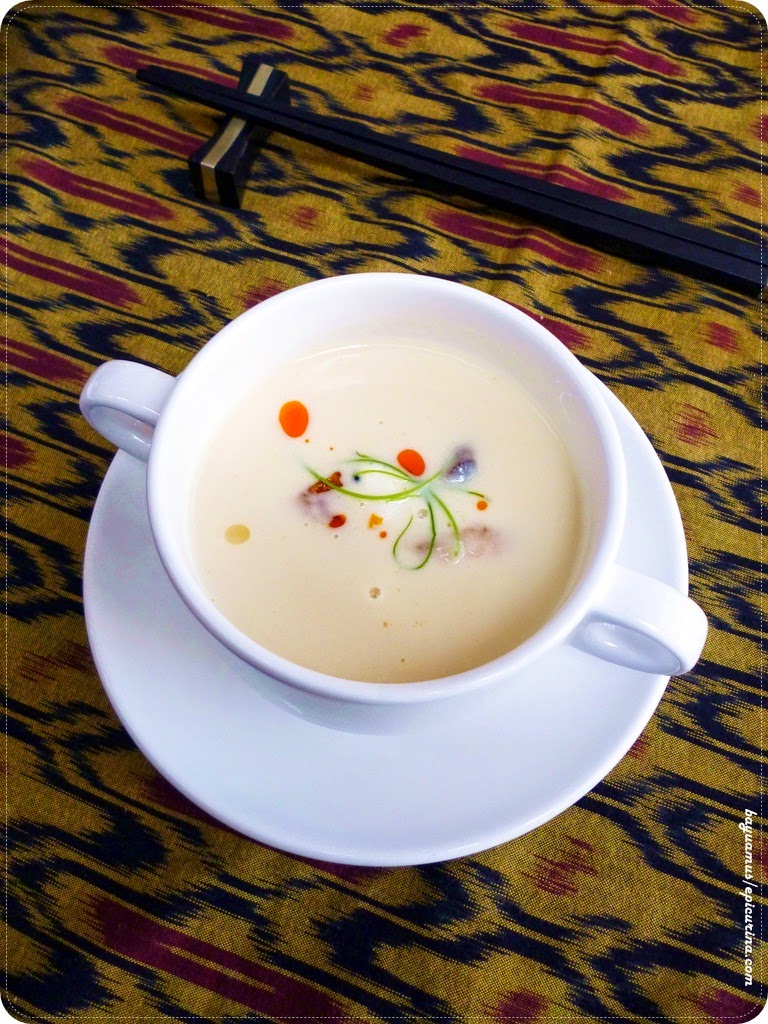
With those tenets in mind, he poured spoonful of Sea Urchin cream into the bottom of the plate, then arranged the pan seared seafood on top of it, poured just enough part of the soup to keep the chunks of seafood visible, dripped a minute amount of chili oil, then finally dressed the dish with micro herbs.
The result as you can see below, looks good and chic enough for the food photo session.
Back in our table, the mass version that Chef Allen's crews created looks less stunning with all of its ingredients submerged (photo below), but it still packs a full amount of foodgasm nonetheless. The chowder was creamy, sweet, full with savory chunks of butter-seared seafood (Chef Allen is a butter fans), however I found the Sea Urchin cream only moderately tinted the overall composition, so it wasn't as much surprising as the Massaman Seafood Curry.
As with the 'plot twist' prepared for this dish, Chef Allen relies on the smoked ingredients to give the Risotto a more robust flavor. He smoked the ingredients himself in the kitchen, involving a mesh-tray, metal canister, and untreated wood sawdust as the smoking agent. He then put the smoked ingredients early just after the Risotto rice is half-cooked to let the smoky aroma embodied throughout the dish.
Putting some Risotto as the base on the plate, Chef Allen then proceed to arrange some chunks of seafood on top, poured two spoonful of Seafood Garlic & Thyme Foam, then sprinkled some micro herb afterward.
The crowd version of the dish on our table looks quite identical, though the foam might have dissolved a bit after quite a while it stays there, left for photo shooting the 'hero' product created by Chef Allen.
While taste wise the Risotto was the lightest of the three, but for me it holds the plot twist that makes it the superstar of that 3 course meal. Why?
Because even though the 'al dente' Risotto rice goes along nicely with the seafood sweet savory broth, and the butter seared seafood adds robust flavor, the plot twist coming from the smoked ingredients introduced early on, was really foodgasmic. The smokiness and milkiness has been deeply absorbed by the rice compound, and it evoked a playful feeling that set the overall tune and taste of the dish. The foam itself only lends a vague garlic and thyme aroma, but it adds balance to the dynamic Risotto flavor.
The late lunch was then closed up with tea & coffee, but I found myself already full with the dishes and the wonderful desserts presented afterward -- including the very delicious marble sized macarons -- so I have to excused myself early from the premise. Beside, I parked in "express park" section of the hotel, and I still have to spare a time fighting the traffic madness at the By Pass Ngurah Rai's new roundabout nearby the Airport.
What I can conclude from the Epicure Indonesia Masterclass with Chef Allen Stevano is that he has a trait in becoming a tutor or lecturer; or even a TV personality. I'm impressed with the amount of information he's willing to share, and how he managed to engage the audience in an interactive conversation.
While I liked the Seafood Risotto the best, and the Massaman Curry next, I believe those three dishes represents well the seaside atmosphere experience of Bali. (byms)
Set by the pool of this newly built Mantra Hotels, Nusa Dua, Bali, all the guests of the Epicure Indonesia Masterclass are first welcomed by Nining Widyawati, Epicure Indonesia's Head of Marketing, then followed up by Chef Allen explaining the dishes that he will cook that afternoon, its ingredients, including the micro herbs he'll be using; collections of tiny living herb and salad leaves harvested at seed or first true leaf stage. They are specially selected for their intense flavors, or visual impact and colors.
Massaman Seafood Curry with Longan and Water Chestnut
Once crowned as the world's most delicious food back in 2011 by CNNGo, Massaman Curry was the dish that opened the audience of Epicure Indonesia Masterclass into the cooking style of Chef Allen Stevano; which brings into table the years of experience in Jakarta, London, Auckland, and Macau. Originated from the muslim populated part of Thailand, Massaman Curry usually consisted of beef, chicken or any other meat allowed by the Islamic dietary law.
While prawn, snapper, and squid certainly belong inside a Seafood Curry, but longan? I recon pineapple is a more common pair, therefore reading longan alongside the seafood on the list of ingredients got me curious. Upon asked why, Chef Allen replied that it's related with "the surprise elements" or a "plot twist" that gives the cooking a nice surprise.
Skilfully preparing the dish, chef Allen guided us through each steps of the cooking process while continuously engaging the audience with explanations, reasons & logic behind different cooking style, help picking up the micro herbs, read out the menu instructions, and even quizzes related to cooking.
Chef Allen also actively involving the guests to taste and assess each stage of the cooking; how does it taste, does it have enough salt, sugar, or whether is there any dominant taste? He did these to continually stresses the importance of tasting the food in each cooking stage, so we can adjust the flavor early to let it infuse, therefore maintaining the overall taste composition intact. Related with tasting, he also set out a rule of 'no smoking' during working hours for his crews, since smoking are known to shift our taste balance.
After minutes of very engaging cooking demo, the Massaman Seafood Curry is finally ready. The one Chef Allen cooked goes to the display table for Epicure Indonesia's documentation (photos and videos), while those prepared by his crews goes into our dining table.
Seafood Chowder with Sea Urchin Cream
Next came the dish Chef Allen promised easy to make, yet still highly satisfying: a chowder; thickened soup usually made up with milk and cream. Chowder differs with cream soup by the existence of vegetable or meat chunks. Originally chowder related specifically to New England's fishermen's stew, and the word itself came from the French chaudiere, meaning "kettle" or "pot."As a common habit, wine are introduced to the chowders liquid as well, it's then simmered until all of its alcohol evaporated to avoid the bitter taste. What's very specific in the dish Chef Allen cooked though, is the inclusion of sea urchin cream. Closely associated with Japanese food, the sea urchin are made into thick earth colored cream, resulting in a creamy and slightly metallic taste.
Just like the first dish, with Seafood Chowder Chef Allen reminded the audience about the importance of "sight, taste, smell" of a dish prepared, and how the flavors should be arranged in layers to create a meaningful taste journey.
With those tenets in mind, he poured spoonful of Sea Urchin cream into the bottom of the plate, then arranged the pan seared seafood on top of it, poured just enough part of the soup to keep the chunks of seafood visible, dripped a minute amount of chili oil, then finally dressed the dish with micro herbs.
The result as you can see below, looks good and chic enough for the food photo session.
Back in our table, the mass version that Chef Allen's crews created looks less stunning with all of its ingredients submerged (photo below), but it still packs a full amount of foodgasm nonetheless. The chowder was creamy, sweet, full with savory chunks of butter-seared seafood (Chef Allen is a butter fans), however I found the Sea Urchin cream only moderately tinted the overall composition, so it wasn't as much surprising as the Massaman Seafood Curry.
Seafood Risotto with Seafood Garlic & Thyme Foam
Then came our last session for that afternoon, where Chef Allen is cooking us a Risotto. Being a very engaging host, he first introduced us to the basic of cooking Risotto; what sort of rice used (he used Arborio btw), what goes into it, then continue the conversation during the cooking process: how much water should you add, watch when the rice starts to turn translucent, the final consistency of a Paella, why he put the ingredients clockwise on the cooking pan, how to create the foam with gelatin and introducing air into it, etc. Very informative it almost feels like I can immediately replicate the dish back at home.As with the 'plot twist' prepared for this dish, Chef Allen relies on the smoked ingredients to give the Risotto a more robust flavor. He smoked the ingredients himself in the kitchen, involving a mesh-tray, metal canister, and untreated wood sawdust as the smoking agent. He then put the smoked ingredients early just after the Risotto rice is half-cooked to let the smoky aroma embodied throughout the dish.
Putting some Risotto as the base on the plate, Chef Allen then proceed to arrange some chunks of seafood on top, poured two spoonful of Seafood Garlic & Thyme Foam, then sprinkled some micro herb afterward.
The crowd version of the dish on our table looks quite identical, though the foam might have dissolved a bit after quite a while it stays there, left for photo shooting the 'hero' product created by Chef Allen.
While taste wise the Risotto was the lightest of the three, but for me it holds the plot twist that makes it the superstar of that 3 course meal. Why?
Because even though the 'al dente' Risotto rice goes along nicely with the seafood sweet savory broth, and the butter seared seafood adds robust flavor, the plot twist coming from the smoked ingredients introduced early on, was really foodgasmic. The smokiness and milkiness has been deeply absorbed by the rice compound, and it evoked a playful feeling that set the overall tune and taste of the dish. The foam itself only lends a vague garlic and thyme aroma, but it adds balance to the dynamic Risotto flavor.
The late lunch was then closed up with tea & coffee, but I found myself already full with the dishes and the wonderful desserts presented afterward -- including the very delicious marble sized macarons -- so I have to excused myself early from the premise. Beside, I parked in "express park" section of the hotel, and I still have to spare a time fighting the traffic madness at the By Pass Ngurah Rai's new roundabout nearby the Airport.
What I can conclude from the Epicure Indonesia Masterclass with Chef Allen Stevano is that he has a trait in becoming a tutor or lecturer; or even a TV personality. I'm impressed with the amount of information he's willing to share, and how he managed to engage the audience in an interactive conversation.
While I liked the Seafood Risotto the best, and the Massaman Curry next, I believe those three dishes represents well the seaside atmosphere experience of Bali. (byms)
Trend Locavore Ubud Bali di Tiger Tales majalah inflight Mandala Airlines
Bepergian dengan Mandala Air bulan Juli 2013 ini? Jangan lupa buka halaman 18 untuk informasi mengenai trend Locavore; mengonsumsi makanan yang tumbuh, dibudidayakan, atau diproduksi secara lokal, di daerah Ubud, Bali, persembahan Epicurina.
Ada tiga restoran yang dibahas, pertama Warung Bodag Maliah nya Sari Organik, yang hanya bisa ditempuh berjalan kaki di pematang sawah selama 10 menitan (atau numpang ojek); kedua Plantation Restaurant di Alila Ubud Hotel yang menyajikan aneka hidangan internasional dengan kadar muatan lokal hingga 95%; ketiga Warung Pulau Kelapa yang banyak dibicarakan oleh para penikmat kuliner profesional, termasuk pak Bondan Winarno dan William Wongso.
Artikel selengkapnya bisa dibaca online di sini (web), atau di sini (pdf). (byms)
Ada tiga restoran yang dibahas, pertama Warung Bodag Maliah nya Sari Organik, yang hanya bisa ditempuh berjalan kaki di pematang sawah selama 10 menitan (atau numpang ojek); kedua Plantation Restaurant di Alila Ubud Hotel yang menyajikan aneka hidangan internasional dengan kadar muatan lokal hingga 95%; ketiga Warung Pulau Kelapa yang banyak dibicarakan oleh para penikmat kuliner profesional, termasuk pak Bondan Winarno dan William Wongso.
Artikel selengkapnya bisa dibaca online di sini (web), atau di sini (pdf). (byms)
Semarak Kuliner Bali di Linked majalah inflight Citilink
Bepergian dengan Citilink bulan Mei 2013 ini? Jangan lupa buka halaman 50 untuk highlight mengenai jajan kuliner andalan Denpasar terkini, persembahan Epicurina.
Menyesuaikan dengan target tulisan yaitu wisatawan nusantara (wisnus), jadi dipilihkan makanannya yang cocok di lidah dan perut masyarakat Indonesia, sekaligus tidak memberatkan kantong karena rata-rata yang dibahas di sini adalah kuliner kelas streetfood (jajanan pinggir jalan), atau restoran casual:
(byms)
Menyesuaikan dengan target tulisan yaitu wisatawan nusantara (wisnus), jadi dipilihkan makanannya yang cocok di lidah dan perut masyarakat Indonesia, sekaligus tidak memberatkan kantong karena rata-rata yang dibahas di sini adalah kuliner kelas streetfood (jajanan pinggir jalan), atau restoran casual:
(byms)
Writing assignment vs Free writing
If you find someone believe in your capability and assign you a writing job, congratulations! One thing you should bear in mind though, writing assignments usually comes with strict restrictions. If you want to keep your client happy, then stick to the rules they laid out.
The restrictions applied itself, usually exist due to different nature of your client's need; what is it for? who their target markets are? where it will be published? And those considerations dictates almost directly about what writing style should be applied, and what sort of information and story it should contains.
And what's not less important, is the media's physical and technical limitations, meaning if the article you need to write will occupy an A4 single page (about 400 words), sending a 1,200 words article wouldn't wow your client, but driving their editor crazy instead.
And if you even have the feeling to debate on the need to expand the article into a three pages feature, please understand that most times that's not even your client's decision, and absolutely not yours to make. Stick to the constraints and you'll get a happy client. Fail to understand that, or write something absolutely different from the concept approved, and you can kiss the hope of future assignments goodbye.
In your search of the story though, most of the time you'll get more story than you need. What you'll do with those? Throw them away?
Don't! Put them all together into a form of free writing; a narrative, and often just-flowing, less structured writing that includes all the stories you capture on the assigned subject. This way you'll get a pool of reference that you could use later on, to write on another assignment. After all just like artwork, no writing is completely novel, it's just the different arrangements and components that goes into your writing that will determine its uniqueness and creativity.
Therefore, as a good practice to apply for writing assignments; do the free writing first, then later scoop from it components that required to form the writing assignment. This way you don't throw away precious informations (which could be useful for your next projects), and your client get what they're looking for, along with the high chance for repeat order. Couldn't imagine a happier ending than that. (byms)
The restrictions applied itself, usually exist due to different nature of your client's need; what is it for? who their target markets are? where it will be published? And those considerations dictates almost directly about what writing style should be applied, and what sort of information and story it should contains.
And what's not less important, is the media's physical and technical limitations, meaning if the article you need to write will occupy an A4 single page (about 400 words), sending a 1,200 words article wouldn't wow your client, but driving their editor crazy instead.
And if you even have the feeling to debate on the need to expand the article into a three pages feature, please understand that most times that's not even your client's decision, and absolutely not yours to make. Stick to the constraints and you'll get a happy client. Fail to understand that, or write something absolutely different from the concept approved, and you can kiss the hope of future assignments goodbye.
In your search of the story though, most of the time you'll get more story than you need. What you'll do with those? Throw them away?
Don't! Put them all together into a form of free writing; a narrative, and often just-flowing, less structured writing that includes all the stories you capture on the assigned subject. This way you'll get a pool of reference that you could use later on, to write on another assignment. After all just like artwork, no writing is completely novel, it's just the different arrangements and components that goes into your writing that will determine its uniqueness and creativity.
Therefore, as a good practice to apply for writing assignments; do the free writing first, then later scoop from it components that required to form the writing assignment. This way you don't throw away precious informations (which could be useful for your next projects), and your client get what they're looking for, along with the high chance for repeat order. Couldn't imagine a happier ending than that. (byms)
Epicurina mentioned on Trubus Magazine
Both me and Epicurina were mentioned on Ed. 505 of Trubus Magazine, Indonesia's leading horticultural magazine, thanks to Riefza. The report is about culinary potencies of sea-urchin.
Most Indonesian food photos owned and used on Epicurina sites (i.e.: website, blog), are available for publication and repost under CC (Creative Commons) license which meant they're virtually free, with some restrictions and conditions. Please visit Epicurina Licensing page for complete details. (byms)
"Alternative Bali Eating Agenda" published on Hotelier Indonesia magazine
My writing on the alternative food choices you can have when exploring Balinese eating scenery; "Alternative Bali Eating Agenda", has been published on the Hotelier Indonesia Magazine No.2 released this month, June 2011
You can get the digital edition online from Scoop Store or from Hotelier Indonesia Magazine website. (byms)
Subscribe to:
Posts (Atom)
Appearances


Follow Us
Follow Epicurina on your platform of choice