Showing posts with label customer experience. Show all posts

Understanding Customers - How to tap into people's emotion and influence their choice

Hi Guys! Some while ago I found an article at Business Insider about people tendency to try something new, vs sticking with what's familiar. It addresses (one of ) the reason why people choose what they choose, including upon choosing what food to eat:
You Want What’s Familiar – A series of research studies by Marieke de Vries of Radboud University Nijmegen, in the Netherlands, shows that when people are sad or scared, they want what is familiar. When people are in a happy mood they are not as sensitive to what is familiar, and are willing to try something new and different.
Related to Fear of Loss — This craving of the familiar, and a preference for familiar brand is probably tied to our basic fear of loss. In de Vries's book, Neuro Web Design: What makes them click? I have a chapter on the fear of loss. When people are sad or scared, our old brain and our mid (emotional) brain are on alert. We have to protect ourselves. And a quick way to be safe is to go with what you know; what you are familiar with. A strong brand is familiar. A strong logo is familiar. So when we are sad or scared we will reach for a brand and logo we know.
It’s Easy to Change Someone’s Mood – It turns out it is remarkably easy to affect someone’s mood, especially in the short term (like long enough for them to make a purchase at a web site). In Marieke de Vries’s research they showed video clips of the Muppets (to instigate a good mood) vs. the movie Schindler’s list (to instigate a bad mood). People reported their mood as significantly elevated after the Muppets and significantly lowered after Schindler’s list. This mood change then affected their actions in the rest of the research study.
Related with food internationalization, I believe the article plays an important part in designing the food experience that would make someone new to try out Indonesian food -- or any other foreign cuisine -- which moves them further on the Food Experience Journey from Discovery into Onboarding stage.


Practically the article also gives a hint that people might give foreign food a try, if it looks like, or somewhat resemble familiar food they have already know.

Which reminds me of this recent encounter with a delicious sandwich from Chef Theodorus Immanuel at Vin+ Bali that looks like ordinary sandwich, but it actually contains something very traditional: A Balinese Ayam Betutu.


Unlike classical Ayam Betutu though, which its flavor spectrum leaning heavily toward savoriness and spiciness, the sandwich capped the heat, while also introduces mild acidity by using pickles, to gives off a "rounder" taste to the Ayam Betutu sandwich. The result is something that in a glance taste quite western, but with a kick of local taste.

For someone with Western upbringing, pairing the Ayam Betutu Sandwich with wine would even make the dish easier to accept, as it mimic the wine and dine culture. Creating a positive ambiance through comfortable room temperature, upbeat music, and uplifting fragrance would make the adoption journey even easier, and more pleasing.

How well would this works? Let me know what do you think. (byms)

Read the complete article here: http://www.businessinsider.com/100-things-you-should-know-about-people-2010-11#24--you-are-most-affected-by-brands-and-logos-when-you-are-sad-or-scared-24#ixzz1AFHTEe2r

Alaya Ubud Resort Relaxing Oasis in Downtown Ubud


Serving as the base camp for our Ubud Food Festival activities is the charming hotel Alaya Ubud. Looks narrow and unassuming from the front, the hotel is actually big, just that it's stretched a couple of hundred meters deep.

Located next to the Yoga Barn, Alaya is easy to spot, and ample of parking spaces are available. There are three main attraction at this beautiful resort hotel: The room (definitely), Dala Spa, and Petani Restaurant with live music performance featuring Bali's best talents. During the day, Petani also serves as a good meeting ground with its elegant chic interior.

Around Alaya Ubud, there's a lot of attraction you can visit by walking, eliminating the need of a cab. A major supermarket sits almost right next to the hotel, 15 minutes walk to the Monkey Forest, and a lot of interesting restaurants and shops only a walking distance away.


The Stay


First, service is awesome, loosely structured and feels genuine, no cliche. With only 60 rooms capacity, this is among the luxury you can experience from the staff in Alaya Ubud. For example, when I got back from my talk in Ubud Food Festival, the guest relation staff recognized me almost immediately, even though I'm sure that was the first time we met. Wanting to quickly get out of my sweat ridden t-shirt from the earlier activity, I was then accompanied by a younger male staff, who's also already know me by name, all the way to my room where my wife and kids are waiting.

On the down side the walk to our room on the third floor was unexpectedly long, given the narrow-deep hotel layout and our room was located quite to the rear end of the resort. There's also no elevator or ramps available meaning we can't carry the baby stroller either.

The view was amazing though. While I'm no stranger to rice fields, since I grew up with rice fields surrounding my house and treat them as my playground, the view is soothing nonetheless. I heard that the hotel bought those rice fields around the hotel, just so it can be preserved as is.


The room itself was simply beautiful. I love how the design makes the room felt cultured, with the texture, colors, and artworks, but not bare traditional, as the in-room facilities and the honeycomb patterned door nicely adds the contemporary feels.

The bowl shaped bathtub with natural lighting was surely gained my 6 years old kid attention, who's favourite hotel activity includes either swimming, or bubble bath, or both. Both the shower and the bathtub occupied an open space though, divided only by curtain with the rest of the room. Suitable for couples and families with little kids, it might feels a bit awkward for those not used to open space bathrooms.

The room was spacious, and its bed was enough to fit the whole crew of 2 3/4 people (2 adults, 1 kid, 1 baby). And what begun as a joke to address the daybed as "kid's bed" ends up with our kid actually slept on it, believing that joke to be true.

Outside of the room (literally), the other wonderful feature of Alaya Ubud's rooms are the balconies. Facing the lush green rice fields, it's equipped with comfy couch perfect to snuggle with your loved one(s), while enjoying the fresh air of Ubud.

While Alaya also have afternoon tea down at Petani as complimentary of our stay, we skipped it as our agenda for the rest of the afternoon was to enjoy the luxury treatment of Dala Spa.

Mesmerizing Dala Spa


Located at the at the hotel's farthest end, Dala Spa's lobby is at the second floor and the treatment room downstairs at the ground floor. What's special with Dala Spa is that each room have different themes, all were elegant and mesmerizing in their own ways.

Surprisingly, Dala Spa also has their own Spa menu which includes a nice set of high tea, with array of unique tea blends.

As we took quite a lot of beautiful shots here, it's only proper to put the Dala Spa experience in its own article. Stay tuned.


Dinner time at Petani Restaurant


For the evening, I heads down to Petani Restaurant. The view turned into dramatic with the lights turned on.


As Mrs. Epicurina suddenly experiencing a terrible headache, I have to enjoy the dinner alone. A pity, but still enjoyable nonetheless, especially with the live entertainment by Bali's own prodigy music artist Balawan.


Known for his double necked guitar and his unique tapping method, Balawan performance that night was both joyful and stunning. Combining intricate tunes with Balinese elements, Balawan combine technical prowess with ethnicity nuance beautifully blend it. This is for sure not your usual dinner band.

Later during the end of his performance, Balawan was also joined by one of his audience in a three way "battle" of scatting, Djembe drum playing, and Balawan mimicking gamelan on his guitar!


To accompany the evening, I ordered Grilled Jimbaran Bay Tuna. Two slabs of thick and juicy tuna, stacked on top of purple potato puree and edamame beans. The tuna was marinated with Kintamani lime and soy sauce, lightly grilled to create the firm surface, while at the same time maintaining the pinky juicy tuna meat inside. Well done!

I did find the dressing of spiced orange reduction a bit challenging though, since the purple potato is already sweet, and the dressing was even sweeter.


Breakfast in Alaya Ubud

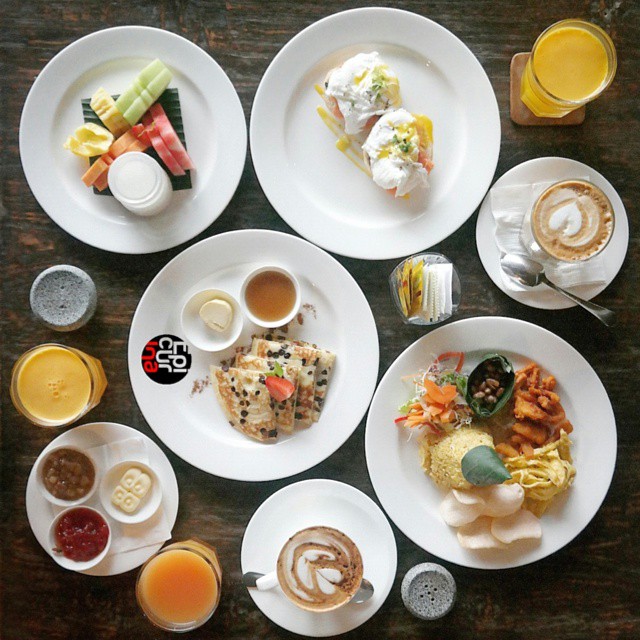
Several options are available for breakfast in Alaya Ubud, you can pick from the Indonesian Nasi Kuning Komplit, Eggs, or Pancake. I certainly went for the poached eggs, on top of toasted baguette, perfected by a layer of smoked salmon. Delish! I always love the moment I sliced the poached eggs open and let the runny egg yolks melted out.

We find the Nasi Kuning a bit too mellow for our local tastebuds though, while our kid certainly enjoyed his freshly made choco chips pancake.

All of the breakfast choices includes a set of sliced fresh fruits, juices, homemade yogurt, bread basket with homemade jams, and a choice of coffee or tea. While it's not a buffet breakfast, it's surely fulfilling.


Conclusion and feedbacks

On overall our stay was awesome, the staffs were attentive, their Dala Spa's High Tea has definitely one of the best savory snacks among all the high teas in Bali. We love the bedroom and the bowl shaped bathtub, and the balcony was relaxing.

I would love to see flavor enhancement on some of their food, and there should be a better way to address family traveling with babies, or with elders, as for both cases the long walk might be an issue.


Where's your favorite place to stay in Ubud? Share with us!

Thank you Alaya Ubud for introducing your lovely resort to our Epicurina readers. As usual, all opinions are of my own. (byms)

The Foodie Experience Journey

Here's a quick introduction into The Foodie (Experience) Journey:

There are four stages in which someone become acquainted with specific type of food, namely the Discovery stage, Onboarding stage, Exploring stage, and last, Mastery stage.


The Discovery Stage

The discovery stage deals with how someone learn about the food's existence, and it could happens both offline and online on the internet, or through other type of media (TV, printed magazine and newspapers, etc.).


Online wise, there's the Google search, Blog, YouTube, Instagram, Twitter, Facebook, and other social media which can be accessed by people from around the world. Creating your content in these platforms thus, will provide a good chance of getting your content discovered by a wide audience.

Offline wise food expo, consulate bazaar, trade and culture exhibition would be a perfect example of how someone become acquainted with foreign food, both in discovering its existence, and goes straight into experiencing it first hand.

For example: there are new documentary videos available on YouTube about Indonesian Food, made by the CIA (Culinary Institute of America) a.k.a "The Good CIA." Through watching the videos, someone is getting curious to find out more about Indonesian food.

The Onboarding Stage

The onboarding stage deals with how someone moved past knowing, into experiencing it. Mostly it happens offline when someone eat the food for the very first time, and getting in touch with the food's related attributes like how the people dressed up in the food's origin country, how the music sounds, and whether there are specific custom with how to consume the food, e.g.: eating with bare hands.


Online wise, some people with advance cooking skill might want to jump into recreating the food and looking for the recipe online. Or when they're already in the food's country origin, they might need an App to better inform them about how to get a specific type of food they've seen on TV or in the news, this is where the mobile application and food blogs would also help.

For example: Someone might read a news in CNN Go that claims Rendang as the world's best dish, and decide to visit the nearby Indonesian restaurant in her city, or the Indonesian Expo held by the Indonesian consulate in the next city, out of curiosity. This is when she experience the first time how Rendang Padang looks, taste, and feel.

The Exploration Stage

The exploration stage deals with how someone getting more interested into the food and start exploring for options. Whether it's looking for something more authentic than what they had, or trying out a different dishes from the same culinary origin.


This is where someone wishes to learn more about the food they have already tasted, and experienced the collateral aspects the food brings.

For example: After the initial encounter with Rendang Padang, someone is curious to try out other Indonesian dishes and visit a nearby Indonesian restaurant where she gets to taste the Sate Ayam Madura, Gado-Gado Jakarta, and Rawon Iga Surabaya.

After continuous exposure with the food then, that someone could become a promoter of the food, sharing his passion to his networks and contacts.

The Mastery Stage

Last the mastery stage, deals with how to keep someone interested in the particular food, even when it seems that someone already knows and experience the cuisine inside-out. This is a critical point that decides whether one will continue its journey in getting to know more about the food and the cuisine style, thus become the authority figure for the cuisine.

Or will she reach the stagnancy as she couldn't get a better resource to satisfy her curiosity?


That's it! I adopted the journey from Customer Experience Design end-to-end journey, and I used this as an illustration to outline the experience steps, in relation with my role as a panellist in Bango's Panel Discussion on "Peluang dan Tantangan Kuliner Nusantara Untuk Masuki Peta Kuliner Dunia" (Opportunities and Challenges for Indonesian Culinary to enter World Culinary Map), early March 2015 in Jakarta.

Based on my own knowledge, and the other panelists' stories, Indonesian food is still struggling on both the Discovery and Onboarding stages, and by knowing this situation, we could get a better picture on what Indonesian government needs to do for each stages, and which one should be prioritized.

As this is still a very early version of the journey, feel free to make comments or suggestions. (byms)

For daily Bali Food Adventure updates

The Coca Cola vending machine unusability

While it might works elsewhere in the world, in Indonesia vending machines like this one possesses customer experience disaster; which in turn severely limiting its usefulness, and finally convincing both users and the business that vending machine just doesn't work.


First, let's have a look at the User Experience disasters, based from the photo above:

  1. "No change provided," meaning users need to provide the EXACT amount of money.
  2. The item prices are Rp. 7,000 which means users must provide 1 piece of 5,000 rupiah banknote, plus 1 piece of 2,000 rupiah banknote or 2 pieces of 1,000 rupiah banknote since Bank of Indonesia doesn't issue a 7,000 rupiah banknote. While it seems like a still sensible request, let's check out the next requirements:
  3. "This machine will not accept folded, stapled, wet, torn, or faded notes." While wet and torn are very common (and logical) restriction, but who in Indonesia these days carried around a pristine, non-folded, not faded, not crumpled 5,000 and 2,000 rupiah bills? Being the banknotes with the least value in Indonesia, they are often resides in back pockets and changes pouch instead of straight long wallets. 
  4. Even though this machine allows multiple transactions, meaning you can purchases multiple items, you're still at the mercy of a pristine 2,000 and 1,000 rupiah banknote: 10,000 + 2x 2,000 for two; 2x 10,000 + 1,000 for three. But if you're into volume buying then there's a hypermarket right behind this vending machine with much better prices, and offers changes.
Since those using straight long wallets are mothers, or people wearing suits; but the last usually stores 100,000 rupiah in their wallets not the 1,000 rupiah banknote, so the most probable target market for this vending machine... are mothers. And while some mothers against their children (and their husband) drinking soft drinks; those who are not, usually don't really feel comfortable with trying out strange machine with all its technicalities and restrictions, out in the open.

And that left us with... people working in Banks, who eventually have an endless supply of pristine banknotes. But since they need to own a straight long wallet, and by habit puts small changes in it, so they got to be mothers too; and the vicious circle continued... 

How to overcome this User Experience disaster and make this vending machine usable and useful?
  1. Provide dedicated change cashiers that's equipped with endless supply of pristine 5,000, 2,000, and 1,000 rupiah banknotes; which actually is the way Coca Cola applied initially with providing a "vending machine attendant" that provides the ideal condition banknotes for the machine. However it turns the machine more into an entertainment device than a standalone autonomous device a vending machine should be.
  2. Set @10,000 item prices to wipe the pristine small change banknotes headache; adds a bonus for each purchase worth at least 3,000 rupiah, or donate it to a social cause so people feel they're doing something good with using the vending machine.
  3. Collaborate with the hypermarket owner nearby to help provides necessary banknotes AND inform the vending machine users that they can exchange their money there. It make sense since the store replenish their banknotes supply regularly.
  4. Change the machine mechanism to accept coins instead of banknotes.
  5. Create products sellable at 10,000 price on these vending machines.
I'm sure there are much more creative ways (or even practical) to solve this issue; what really matters is that conscious steps are taken to solve this issue. Else they are indeed aiming at a very narrow niche. (byms)

Improving The Waiting Experience


People are emotional beings, we measure most things in our live based on how we feel about them instead of how it really happens, hence perception often takes precedence over facts, or over actual measurement.

The same case happen when people are put into a customer's role, and having to wait for their food to be served when they're eating out in a restaurant. A very fat chance is, if you feel bored, 10 minutes are probably too much a wait, while if you feel excited while waiting, 15 minutes passed quite effortlessly.

Hence the key of providing positive waiting experience lies in the restaurant's ability to provide their customers with involving and interesting activities.

This is what happen when I visited Hazara in Jl. Agus Salim, Jakarta quite a while ago; interesting restaurant ambiance, charming dining company, and comfy on the floor seating complete with fluffy pillows, are more than enough to make me feel occupied and excited for the duration of our food to finally arrive even that it passed the 15 minutes mark. On top of that, the premise also provides various table games both from local origin (congklak) to a more obscure origin games like card games or backgammon. They also have a mini pool-table free for customers to play with.

On another occasion and different topic, same positive waiting experience happens at this modern barber shop Citi: Cuts at Sarinah bldg, Jl. MH Thamrin, Jakarta. They provides the latest Men magazine, e.g.: FHM, Maxim, Cinemags, which makes waiting time passed so fast it even felt disturbing that your turn comes too soon -- while on reality I waited for a barber to finish his half-done job on a customer's hair, which normally takes about 15-20 minutes.

So if you're a business owner, which one would you aim for: the actual length of waiting your customer must endure? Or the quality of experience your customer is having while they're waiting?

Improving The Waiting Experience

As mentioned in the beginning of this writing, the Waiting Experience could be improved by providing things that could get your customers to be involved in an interesting and exciting activities while enduring the wait, e.g.:
  1. TV with favourite channel showing (e.g.: Sports for men, reality shows for women, cartoon for kids, music for teens)
  2. Live music
  3. Interesting reading materials (e.g.: Fashion magazine for women, Men magazine, Newspaper, etc.)
  4. Free starters (e.g.: bread sticks, crackers, etc.)
  5. Free WiFi (if your customers have mobile devices, or if you want to attract customers from this category)
  6. Table games (e.g.: Snake and Ladders, Backgammon, UNO Cards, etc.)
  7. Physical games (e.g. Pool tables, Dart boards, Table football)
Should you think you have taken care of the food-waiting experience, and another Customer Satisfaction Survey verified that, then let's not forget "the other" waiting experience that you have to also take notice; the waiting experience for the bills, since it also requires your customers to wait.

Waiting for the bills - The other Waiting Experience

A good eating experience preceded by good waiting experience could still result in a negative satisfaction if customers have to wait too long for their bills to arrive, and their payment to be processed.

It remind me of this lovely semi-outdoor restaurant in Bandung, the Cafe Halaman at intersection of Jl. Siliwangi and Jl. Taman Sari. In the mid nineties, the place was so popular it was hard to even get parking space on weekends.

The food is great, prices are very friendly -- even for my college year's pocket, and the ambience is just wonderful, a good place to have dinner with your buddies, or for a date -- if you can stand the chance of encountering your fellow college buddies there, which most likely would happen.

A big minus of this place however, was the length of time it requires to greet the customers; welcoming them to the premise, and showing them their seat including handing the menu. What more likely to occurs is customers look for empty seats, occupy it, and then waving helplessly at the waiters to have their attention. And it wasn't because of the super busy peak hours; it was just the waiters are not trained to be attentive; e.g.: standing in their post unoccupied but doing something not service-related, staring mindlessly or maintaining their attention into areas outside of the dining floor, etc.

The other constantly annoying thing is the amount of time they requires to calculate for the bills; one measurement resulted in more than 30 minutes of waiting, while on other occasion it even allows us to leave the place without getting noticed and get into our car.

Outside of potential uncollected profits when customers leaving without paying, negative bills waiting experience simply hurts your business reputation.

As in my case, I informed the waiter in front of the entrance anyway, and it still requires another 5 minutes of waiting.

Improving The Other Waiting Experience

When a customer is done with his eats, there might still be activities they involved in, e.g.: having a chat with their dining partners, discussion over a topic, working on their laptops, updating Facebook status, etc. For these kind of customers, long wait for the bills is tolerable. However on majority, your customer have something else to do elsewhere after their eats, or even pressed by time to get into another activities after the eats, hence making short wait for the bills is very important. In this case, involving your customers into another activities to compensate the wait might not be the best option. You need to find ways to cut down bill preparation time, period.

Orders might get recorded incorrectly, assigned to a wrong table, or even not recorded at all, especially when it is additional. Having to rearranging and reviewing them during bill preparation could be complicated and takes time. Having a good track to what your customers are ordering then, is very important.

A good order recording then, is the crucial element in bill preparation, and it occurs in the very beginning of your customer servicing process.

Afterward a good reliable order calculating tools would become handy. No it doesn't always require fancy high-tech high-cost computer application, as some restaurants could still perform well with calculators, or even abacus; for eateries with only few dishes. For restaurants with a lot of menu choices, and high occupancy rate, then it's a different case. What important is to carefully inspect what your restaurant needs, then adopt the necessary tools.

Depending on your type of restaurant, processing the bill at the same time with processing the food order could greatly diminish this bill-waiting time thus resulted in positive bill-waiting experience. The catch is, your customers would be required to pay upfront for the meal, which gives the fast-food like experience thus hurtful for a more established eateries' image and perception. However it works well for mass targeting restaurants where ambience and perception of high class takes a back seat in customers' priority. (byms)

Customer Satisfaction Survey - Measuring Waiting Experience instead of waiting time

The Customer Satisfaction Survey

Last weekend on my visit to the new MM Juice outlet at Kasih Ibu Hospital at Jl. Teuku Umar, Denpasar, after our lunch is completed the waiter handed us a customer satisfactory survey to fill out.

It's a regular feedback form where the business (in this case MM Juices) tries to gain insight into their customers satisfaction level, and it also contains regular questions like how their food was, their hospitality was, hygiene and cleanliness, etc.

One thing strikes my mind though, upon inspecting the first question on the list: "How long have you waited for the food to arrive?", and upon the answer choices there's "less than 5 minutes", "5-10 minutes", and so on. What made me thinking is, do we as customers really timed the length of time lapsed before our food arrives on our table, in minutes?


Timed no doubt, but in actual minutes? Which one of you have a good reliable measure of time? Can you say that you've been reading this writing for 45 seconds? One minute and 15 seconds? I doubt any of us common customers have that accurate measurement when it comes to timing; especially lapsed ones. Different case would be, if we are asked beforehand to do the measurement, then we would perhaps armed ourselves with a stopwatch, or at least consciously looking at a watch and make a mental note.

(Else if you are food critics that incorporates actual time measurement into your review subject).

A more interesting (and more reliable) result would be, if the question and answers are rephrased to gain emotional response than quantified, i.e.:

Q: "How long have you waited for the food to arrive?"
A: "short/average/long/unacceptable"

Q: "How do you feel about the waiting time between making the order and the food to arrive?"
A: "short/average/long/unacceptable"

While it's true that you won't get a quantified result from such question, but your customers should not be treated as a time tracking feedback mechanism anyway; people, especially regular customers operates more on feeling than objectiveness.

What can you do to make the waiting time more bearable then? Or even more meaningful?

It could be achieved by taking into calculation the other aspect of waiting, which is the "waiting experience".

The Waiting Experience

People are bad time measurer, but the more important fact is, people don't base their response on factual timing but more on the perception of timing; hence how the waiting time makes them feel is far much important than the actual time spent upon waiting.

This is why with a good waiting experience, 15 minutes feels short, while with a bad one, even 10 minutes are already too long.

On eateries with most of their dishes are prepared from fresh where longer preparation time is unavoidable; measuring the other aspect of waiting, the "waiting experience" -- on surveys, could also provide a more useful insight into the customer satisfaction level:

Q: "What did you do while waiting for the food to arrive?"
A: "Watching TV/reading magazine/going online using free WiFi/playing table games/conversation with other guests/nothing"

(Note: please make sure you make all those options available -- except for "other guests" -- , and not relying on customers to brings their own!)

Afterward you can follow up with a question like:
Q: "How do you find the waiting time is?"
A: "Satisfying/acceptable/too long"

Does it works only on those kind of restaurants? On the contrary; for eateries with shorter food preparation, e.g.: fast food restaurant, and buffet style restaurant, this kind of question could provide an even more useful insight into your customer satisfaction level; especially when time of preparation is considerably instant or requires only minimum time.

Combining the measurement

Should for any reasons you still insist on customers doing the timing measurement, you should tell them beforehand about the survey, and don't forget to have a readable watch displayed on any of the walls visible to the customers. This way you can avoid wild guesses, thus gain a more accurate result which you can act upon; however it might annoys the customers, or even makes them over judgemental about your service since you put them into the Jury mode.

For a more accurate result and less obtrusive means, you should let technology handles the technical aspects of your survey; have a stopwatch or other timing device that could measure the time it takes between the waiter enters the order note, up into the food is served on your customer's table, and do it automatically or with semi-automatic triggers. At the same time, held a survey to measure the satisfaction level your customers have; this way you could measure both the preparation time average, and how it makes your customers feel. (byms)

Appearances